

Not every adventure has to become a destination
Why Arctic Adventure does not organize multi-day treks on Spitsbergen
By Henk-Jan Geel, founder and expedition leader of Arctic Adventure
“Why don’t you actually go to Spitsbergen?”
I get that question regularly. And honestly: I understand it very well.
Spitsbergen is one of the wilderness areas that appeals to me most. Glaciers that continue for miles. Fjords, mountains, valleys where you can walk for days without encountering a soul. Exactly the kind of landscape I love and where I like to organize expeditions: small groups, tents, pulks, a few weeks completely outdoors.
Yet Spitsbergen is deliberately not on our program.
Not because it is too far away. Not because we lack experience with expeditions in Arctic conditions. And also not because a safe expedition there would be impossible.
The reason is the polar bear.
Or rather: the question I must ask myself before I enter its habitat with a group of people.
A rifle is part of the equipment
Polar bears live on Spitsbergen. The Norwegian Polar Institute estimates that about 300 animals stay relatively permanently around Svalbard. Added to that are polar bears that travel with the sea ice and cover great distances.
Anyone heading out beyond the villages must take this into account. The Norwegian authorities mandate appropriate precautionary measures and means to deter polar bears. Carrying a firearm is strongly recommended.
For a multi-day tent expedition, this means in practice: a rifle with the group, a bear alarm or bear fence around the camp, and a bear watch at night. Someone who stays awake and keeps an eye on the surroundings.
These are not strange measures. These are sensible measures.
As an expedition leader, I work with risks daily. I create safety plans, think about emergency scenarios, and choose my equipment carefully. The safety of my participants always comes first.
But at a certain point, you have to go a step further than the question: can we do this safely?
You must also ask yourself: what happens if all precautions are not enough?
The answer is not pleasant. If a polar bear poses a direct threat to my group, I must intervene. In the extreme case, that means I have to shoot a polar bear.
And that is where I draw a line.
Why should a bear pay for our pleasure?
Why should I be prepared to kill a polar bear, just because I want to camp in its habitat with a group of people?
Of course, we do this because we love it. We want to experience nature, push our limits, be away from everything for a while. But let me be honest: ultimately, we are guests. Tourists, even.
I find it too high a price if a wild animal might have to pay with its life for our adventure.
An encounter with a polar bear does not have to lead to a dangerous situation. Professional guides do everything they can to prevent confrontations.
But sometimes things still go wrong.
In August 2022, a polar bear entered a tent camp on Sveasletta. A group of 25 people was staying there. A French participant was injured in her arm. The bear was shot. The seriously injured polar bear was subsequently killed by the Norwegian authorities.
In 2026, two polar bears were again shot dead during separate confrontations on Svalbard. In both cases, the authorities concluded that it was a matter of necessity.
I do not condemn the people involved. When human lives are in direct danger, I understand that you defend yourself.
But these are situations that I prefer not to create myself.
The figures also deserve nuance
Research into confrontations between humans and polar bears on Svalbard shows, incidentally, that the number of killed polar bears actually decreased between 1987 and 2019, despite growing tourism.
Whether the total number of encounters has increased? We don’t know. Not every encounter was systematically registered.
So I don’t need to make the danger bigger than it is to explain my choice. For me, it’s not just about the chance that something happens. It’s also about the possible consequences and the question of whether I want to consciously seek out that risk.
A polar bear on our trail in Greenland
Now you might think: but don’t you also go to Greenland? Don’t polar bears live there too?
True.
And I have experienced there myself how close a polar bear can be to you, without you noticing a thing.
In 2025, I crossed the Greenland Ice Sheet with a team. We departed from the east coast and trekked westward with skis and pulks, towards Point 660 near Kangerlussuaq.
Two days behind us walked another expedition team. They partly followed the same trail we had left behind.
After the expedition, I was already back home in the Netherlands. Then I was sent a photo by someone from that other team.
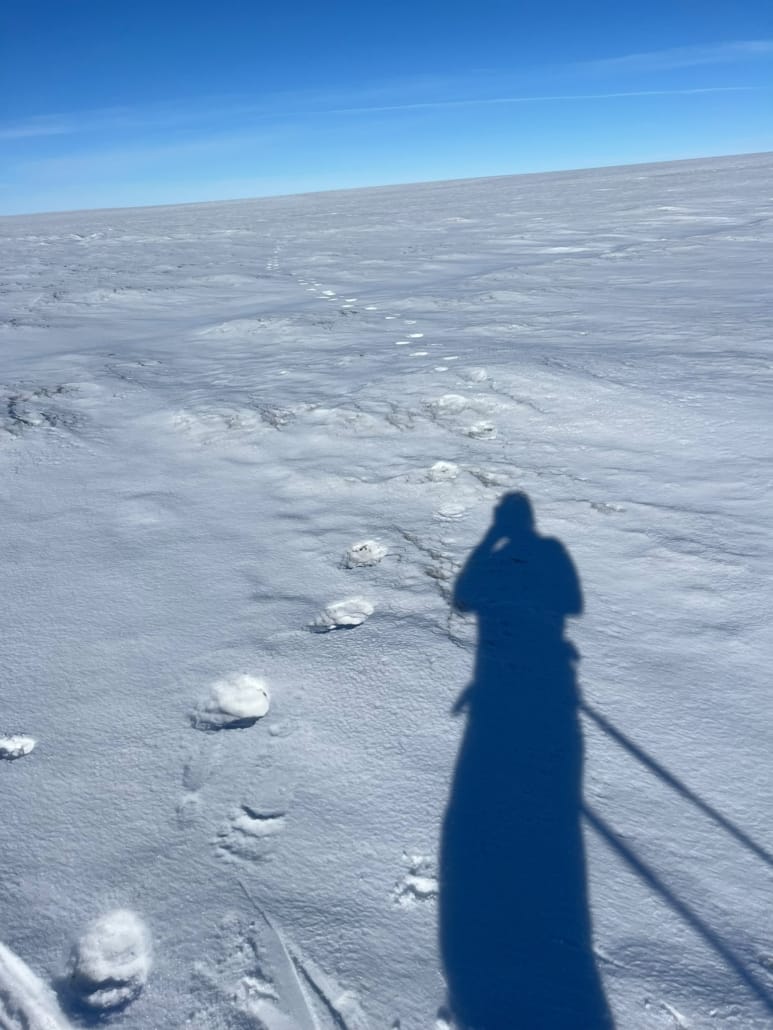
In that photo: polar bear tracks.
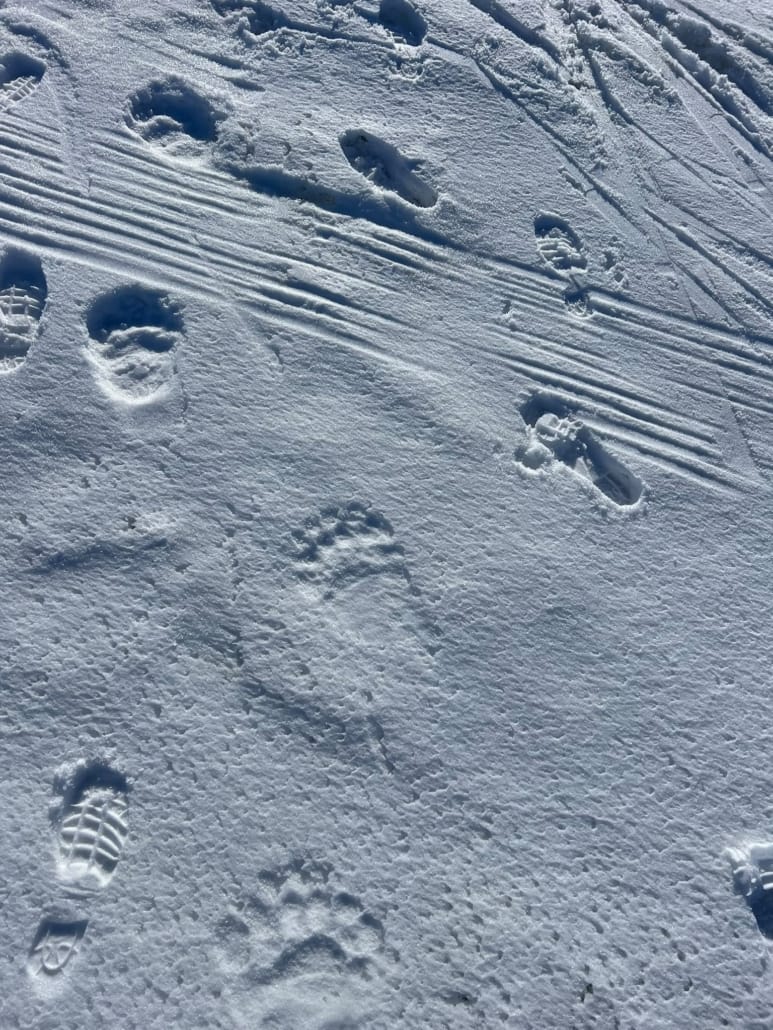
Tracks of a polar bear on the Greenland Ice Sheet
Not just anywhere in the snow. No, on our ski trail.
According to the observations of the team following behind, the bear had come from the south and then followed our trail for about three hundred meters in a westerly direction. Then the animal turned off to the north.
A polar bear had thus literally walked in our footsteps.
Maybe it was a young animal exploring new territory. Maybe it was curious about our trail. We don’t know.
We never saw the animal. There was no confrontation. And I don’t know how much time passed between our passage and that of the bear.
But that photo made something very concrete.
Even if you see nothing for days, you are not alone.
Why do we go to Greenland then?
That is a fair question. And it would be too easy to say that the risk in Greenland is negligible.
It is not.
During a Greenland crossing, I also bring a rifle. In the coastal areas, we take extra precautions. During the first few days, the rifle lies on top of the pulk, directly within reach. It is loaded, but not chambered. At night, we keep bear watch.
Polar bears are strongly connected to the sea and sea ice. They mainly hunt seals, often from the ice. Their presence is therefore mainly related to coasts and areas where sea ice is present.
The further we trek onto the ice sheet and the greater the distance to the coast, the more the risk profile changes. After about thirty kilometers, we find ourselves in very different terrain. In my estimation, the chance of an encounter there becomes significantly smaller.
But it is never zero. And as soon as we approach the other side, the situation changes again.
Those polar bear tracks from 2025 remind me that you can never blindly trust a previous risk analysis. With every crossing, I look again at the season, the route, the conditions, and the possible presence of polar bears.
I cannot prove with hard figures that the risk on our Greenland route is smaller than during a tent expedition on Spitsbergen. A reliable direct comparison is lacking for that.
But the difference lies in the nature of the trip.
On Spitsbergen, during a trek, we would remain for long periods in areas where polar bears can occur. During a Greenland crossing, we move from the coast into the interior, where the risk profile changes.
That doesn’t make Greenland risk-free. And my choice is not sacred either.
But for me, responsible travel means precisely: making these considerations consciously, explaining them, and constantly re-evaluating them.
The same thought on the Hardangervidda
This way of looking at things doesn’t stop with polar bears.
Take the Hardangervidda in Norway. Since 2018, we have organized the Heroes of Telemark there: a winter expedition on skis through an immense mountain landscape.
The Hardangervidda is not only beautiful. It is also an important habitat for wild reindeer.
And those reindeer are not doing well.
The population is under pressure. Diseases and changes in the ecosystem play a role, but so do human activities. Roads, hiking trails, ski routes, huts, and recreation can cause reindeer to avoid important areas or prevent them from using their old migration routes properly.
The Norwegian government is therefore working on measures to improve conditions for the wild reindeer. In April 2026, a joint plan for hiking and ski routes on the Hardangervidda was established. In July, a national action plan for the protection of wild reindeer followed.
This includes proposals to reroute or abolish paths, limit disturbance, and adjust access to vulnerable areas.
Not every measure is immediately legally binding. But the direction is clear: our activities must take more account of the reindeer’s living space.
That is why I actively seek contact myself with the authorities involved in the management of the Hardangervidda. I want to know where the vulnerable areas are, what is happening, and how I can align our routes accordingly.
Not just to comply with the rules. But primarily to understand why those rules exist.
If a route we have used for years no longer fits the reindeer’s habitat, then we must re-examine that route. Even if it means we have to adjust part of our expedition.
Nature is not obliged to adapt to our travel planning.
Not everything that can be done, should be done
I understand the appeal of remote areas. I like to push my own limits. I enjoy preparing complex expeditions and guiding people who discover they can handle much more than they thought.
But not every remote area automatically has to become a destination.
As humanity, we already ask a great deal of nature. Space, raw materials, infrastructure. And we travel to increasingly distant places.
Arctic Adventure is also part of that.
Our participants fly to Arctic destinations. We use equipment, consume fuel, and cause emissions. No matter how carefully we work: every expedition leaves a trail.
So I’m not going to claim that our expeditions are fully sustainable. They are not.
I do try to keep our impact as small as possible. With small groups, carefully chosen materials, and attention to the natural areas we travel through. I want participants to understand where they are and the responsibility that comes with it.
Arctic Adventure is also affiliated with 1% for the Planet. Through this, we support organizations committed to the environment.
But even that doesn’t automatically make an expedition responsible.
For me, responsible travel doesn’t start with the question: how do I carry out this expedition as safely and carefully as possible?
It starts with the question: should we be organizing this expedition at all?
There are destinations that are commercially interesting. Areas where I could organize fantastic expeditions and where people really want to go.
But I don’t want our offering to be determined only by what is possible, what sounds adventurous, or where the money is.
I also want to look at what our presence means for the environment.
Sometimes that means choosing a different route or adjusting a travel period. Sometimes avoiding a vulnerable area. And sometimes it means I decide not to go somewhere at all.
My limit is not a judgment on others
There are professional expedition organizations that have been active on Spitsbergen for years. With experienced guides, good procedures, and a lot of knowledge of polar bear behavior.
I have respect for their work.
I also understand that tourism can bring something good. It can contribute to nature awareness, local employment, and support for the protection of special areas.
So I don’t think other organizations shouldn’t organize expeditions on Spitsbergen. And I’m not claiming that my choices are the only right ones.
This is my personal limit.
I don’t want to end up in a situation where I have to shoot a polar bear dead because I chose to camp in its habitat with a group of tourists.
Of course, there are safety measures. And of course, I would act if my participants were in direct danger.
But the fact that you can professionally manage a risk doesn’t automatically mean you should want to take it.
Tracks of a polar bear on the Greenland Ice Sheet
Sometimes not going is the best choice
I founded Arctic Adventure out of my love for nature. And from the conviction that people can grow enormously when they step outside their comfort zone.
That conviction has only grown stronger over all these years.
I want to continue taking people to special places. To areas where you are on the move for days, where the landscape determines the rhythm, and where you learn to trust yourself and your team.
But for me, adventure is not an end in itself.
It must go hand in hand with respect for the place where we are guests. That respect starts with the choices we make beforehand.
The polar bear tracks on our ski trail in Greenland remind me that we never have full control over nature.
The protection of wild reindeer on the Hardangervidda shows that even familiar routes sometimes need to be re-examined.
And Spitsbergen is for me an example of a destination where I deliberately draw a line.
There are plenty of beautiful areas where I can organize challenging and meaningful expeditions, without consciously accepting the same risk of a deadly confrontation with a polar bear.
That is why I do not organize multi-day treks with tents on Spitsbergen with Arctic Adventure.
Not because we cannot get there.
But because I believe we don’t necessarily have to be there.
Nature does not have to make way for our adventure everywhere.
Sometimes we must make way for nature.
Henk-Jan Geel
Founder and expedition leader, Arctic Adventure
Sources and background
- Norwegian Polar Institute: polar bear population and habitat around Svalbard
- The Governor of Svalbard: regulations regarding firearms and polar bear protection
- The Governor of Svalbard: incident in tent camp, August 2022
- The Governor of Svalbard: investigation into two killed polar bears in 2026
- Vongraven et al. (2023): killed polar bears, human presence and sea ice
- MOSJ: official monitoring of killed polar bears on Svalbard
- Hardangerviddarådet: joint hiking and ski route plan, April 2026
- Norwegian Government: action plan for wild reindeer Hardangervidda, July 2026


 Facebook
 Instagram
 Pinterest
 LinkedIn
 YouTube
 WhatsApp
 Arctic Adventure Happenings





Leave a Reply
Want to join the discussion?Feel free to contribute!