
Adapting to the Arctic rhythm: challenges and solutions
Listen to the Greenland Expedition Update
Sign up for the Expedition Newsflash.
Receive alerts of new blogs in your email during the expedition.
Bad night and day-night rhythm
The alarm went off at 5 AM and we were supposed to leave at 7 AM. Everyone actually slept poorly because it was still very bright here at 7 PM. In fact, it doesn’t get dark at all anymore. The sun sets around 11:30 PM and rises again around 4:30 AM, but the twilight lasts quite a long time. This means it never really gets completely dark. It was super difficult to get into our rhythm.
First full day in the routine
Today was also the first full day in the routine, with 7 shifts of 1 hour each and then a 10-minute break. We actually take 12 minutes each. With that deep snow, these are actually lonely days, because you don’t want to walk next to each other as that’s a waste of energy. So we all walk one behind the other. We are together and yet a bit alone, everyone alone with their own thoughts. During a shift change after 12 minutes, when the next person takes over, we give a quick high five or a nod of “well done mate”. During the breaks, there isn’t really an opportunity to talk to each other either, because those breaks require full concentration. We only have a 10-minute break and everything has to happen in that time: eating, drinking, peeing, possibly changing clothes, checking your hat, and organizing the break spot. It’s really tough.
Break routine and tight timing
After the tent routine, which we’ve more or less mastered by now, we now have to find a break routine. Why is it so important not to take a break longer than 10 minutes? Firstly, because if you take a long break, you get cold quickly. But also: imagine you leave 2 minutes late every break and you do that 6 times a day, that means you lose 12 minutes a day that you could have been walking. If you do that for 30 days, you’re at 360 minutes. So that’s 6 hours and almost a full stage per day. What a waste. That’s why we are very strict about everyone having everything done within those 10 minutes and being truly ready to leave after 10 minutes.
Evening in the tent and organization
In the evening, we gather in the tent to eat together and share experiences. Because the tent routine is now a bit more established and everything goes much smoother, there is slowly some time to relax in the evening. Because from early morning, you’re basically working with full concentration to do everything as efficiently as possible. When you get up it’s cold, so you want to leave as quickly as possible so you can start walking and get warm. Then we have the routine for the day, and in the evening, a lot of snow has to be melted and your gear for the next day needs to be sorted. When you’re in the tent with so much gear and so many people, it’s very organized and regulated, and then suddenly a glove is missing, or a sock, or a spoon. You name it, it’s a bit of a mess in every corner.
Agreements on breaks and approach
Tonight we talked about that post-tent break time. We decided that from tomorrow, we’ll do one ‘Rolo break’ during the day. We’re going to make one break five minutes longer, which means we won’t be on the move for eight hours, but eight hours and five minutes, because we’re going to make up those five minutes. We’ve already agreed that if you don’t manage a ‘tent event’ during the break, the rest will just pull for you, because we’re in the snow. The person in front is certainly not the fastest one pulling there at zero meters. This means that if you need a whole break to finish your things, you’ll walk at the back afterwards. The person in front then keeps an eye on the back to see if we need to help pull people along. Tomorrow we’ll see how that goes.
Distance, progress, and waypoints
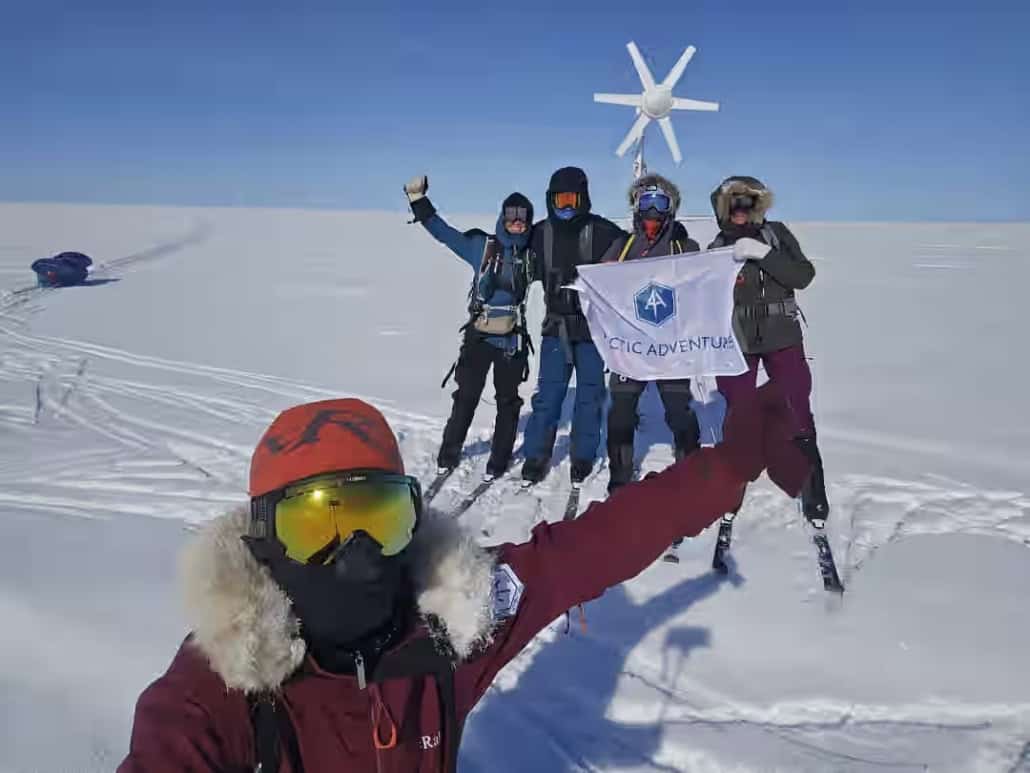
Today we actually covered more distance. The first time we’ve done that from early in the day without any problems, the first time we’ve covered 20 kilometers, and we also reached a second major point, namely the weather station of Dirk van As (our supporting meteorologist). We have a number of points on the route, from west to east. It’s divided up a bit because that makes it easier. The first was getting out of the icefall. We managed that. The second was the weather station. Now we are on our way to DYE2, which is the abandoned radar station from the Cold War.
After that comes the point where we are halfway in terms of kilometers, then the point where we are at the highest point of the ice sheet, and then we look for the finish. We’re still between 5 and 10 days away from that. A section has been completed and we’ve gained some ground. We’ll see if we can keep it up again tomorrow. The strategy worked, because the snow was much better. We’ve all decided that we’re just going to tackle it this way. See you tomorrow.




 Facebook
 Instagram
 Pinterest
 LinkedIn
 YouTube
 WhatsApp
 Arctic Adventure Happenings



Leave a Reply
Want to join the discussion?Feel free to contribute!