

Greenland Expedition: Surviving in the Monotonous White World
Listen to the Greenland Expedition Update
Sign up for the Expedition Newsflash.
Receive alerts of new blogs in your email during the expedition.
Day 8 of the Greenland Expedition
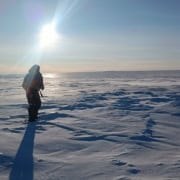
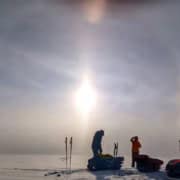
Today is Thursday, August 21, and we are on the eighth day of our expedition in Greenland. This morning, we set off an hour earlier than usual, thanks to our increasing efficiency. While we needed two and a half hours to get going at the start of the week, today we were ready to go within an hour and a half. The day was quite monotonous. We followed the same course as the past few days, namely 310 degrees, and once again covered more than 25 kilometers. The view remained unchanged: it was white everywhere around us. The outlook for tomorrow is the same, but this monotonous environment does offer room for reflection. We still have to ascend 500 meters with our heavy pulkas, which have become slightly lighter by now due to the consumption of food and fuel. The ascent is spread over 100 kilometers, which amounts to a rise of only 5 millimeters per meter. This sounds manageable and gives us confidence that we will make it. Today we noticed that the terrain became flatter, as we were able to remove the climbing skins from our skis. These skins, which act like a kind of carpet under the skis, ensure that you can only glide in one direction. Without these skins, we could move more smoothly and reached a distance of 27.1 kilometers, a new record for our team.
A Quarter of the Expedition Completed
With this distance, we have now covered a total of 155 kilometers, which means we have completed a quarter of the expedition. In terms of food, we are slightly above a quarter, so we need to keep a close eye on that. Fortunately, we are now out of the danger zone on the east side of Greenland. The first 30 kilometers were in the area where polar bears are found. This was followed by a zone of about 120 kilometers with the risk of Piteraq, powerful polar winds that can reach speeds of up to 300 kilometers per hour. Against polar bears, we have flares and, in extreme cases, bullets, but nothing can withstand a Piteraq.
The Origin of Piteraq
A Piteraq is caused by cold air rolling down along the ice sheet. Compare it to marbles rolling slowly toward the edge of a bouncy castle: the closer to the edge, the faster they go. The wind follows the same principle and reaches its highest speed at the edges of the ice sheet. Fortunately, it is currently warm due to the sun, and Piteraqs mainly occur in winter when it is extremely cold. We therefore plan our expedition around late August or early September to avoid both meltwater and Piteraqs. All in all, we learned a lot today about these fascinating natural phenomena during what would otherwise have been a boring day. Now we are going to eat and prepare for a new day tomorrow.





 Facebook
 Instagram
 Pinterest
 LinkedIn
 YouTube
 WhatsApp
 Arctic Adventure Happenings





Leave a Reply
Want to join the discussion?Feel free to contribute!