
An unfortunate turn in the expedition: Evacuation from the ice sheet
Listen to the Greenland Expedition Update
Sign up for the Expedition Newsflash.
Receive alerts of new blogs in your email during the expedition.
Message from Karin and conditions along the way
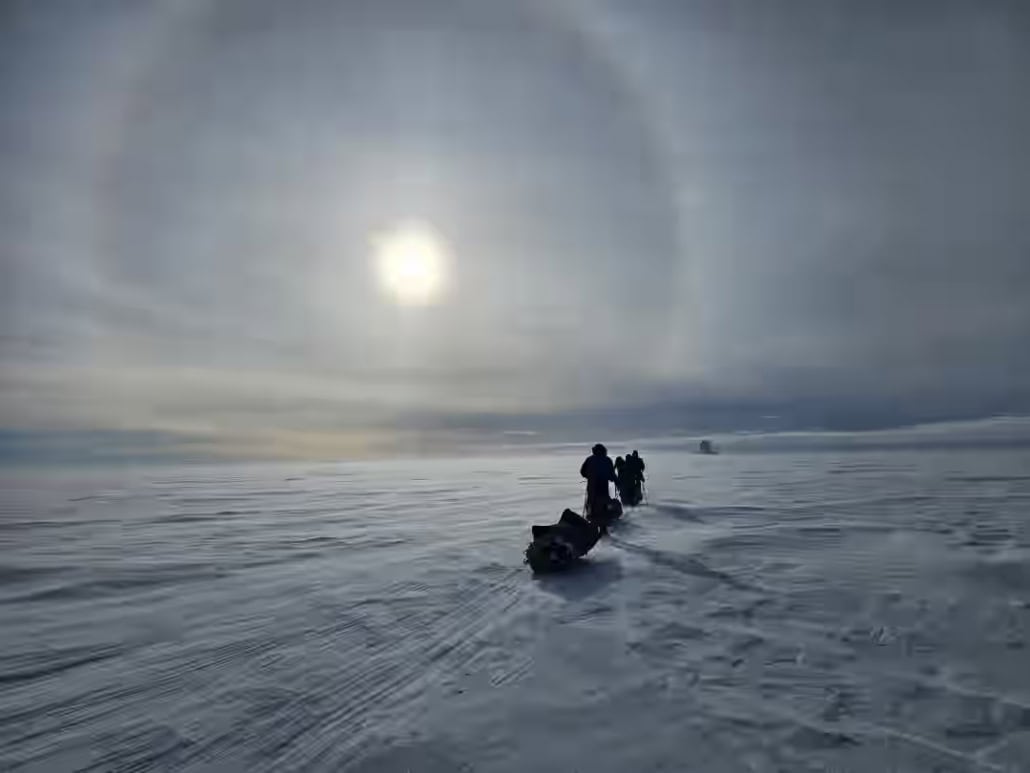
Right now you’re hearing a different voice, Henk-Jan. I received a message from Karin that lasted only a minute. It was cut off halfway and was actually impossible to hear because of so much wind in the tent. But I’ve had a lot of contact with Karin today and I can certainly tell you how the team has been doing. Today was another very tough day. This morning, the team slept 13.5 kilometers from the abandoned radar station Dye-2. The wind still hasn’t died down. They started very early this morning to cover those last 13.5 kilometers. After about ten kilometers, the wind started blowing so hard that the team could no longer see the abandoned radar station through the drifting snow. I could see that they lost sight of the radar station because I saw on the tracker here that the course they were walking drifted a bit more to the south. I also saw that the team halted for a while and probably took a break for an hour or an hour and a half, before finally covering the last two kilometers to Dye-2.
Arrival at Dye-2 and abandoned equipment
At Dye-2, they were able to enjoy a bit less wind for a moment. Dye-2, the abandoned Cold War radar station, is still standing there and was actually left in a huge rush. You can still find tables and chairs, some plates, mugs and cutlery, and also some spare equipment. What you’ll also find there is repair material left for our expedition team by two other teams: the Icetrek expedition team, which is a day ahead of the Arctic Adventure team and comes from New Zealand, and a team from Polar Explorers from Canada led by Annie Aggens. They left materials for Karin’s team to finally be able to repair the skis properly. Furthermore, an extensive search for repair supplies was conducted in the abandoned radar station.
Pushing on to Camp Raven and the physical toll
After leaving the radar station, the participants continued a bit further. They didn’t sleep in the radar station. Everyone was tired and Jasmijn was very exhausted, but they still chose to push on toward Camp Raven. At Camp Raven, there are currently four Americans who manage the landing strip there. During the summer months, Camp Raven is used by the US military to train for landings on snow and ice.
There’s another, less pleasant reason for pushing on to Camp Raven. The past fourteen days, during which the team has been working hard on the expedition, have taken a massive toll. Not just on the equipment—skis have been damaged, tent poles are bent, and a ski pole is broken—but the team has also had a very hard time physically. Several people have blisters, but for Jasmijn, it has been a very, very tough expedition.
Decision to evacuate
In close consultation with the doctor from Extreme Medicine in the Netherlands, it was decided to unfortunately end the expedition for Jasmijn. It’s not that there is a very serious situation right now, but the effort Jasmijn has put in—which is incredible—has taken its toll. If this were to continue for another week, the consequences could be more drastic, with all that entails. Camp Raven is a place where they can find semi-shelter and where support is possible from the American soldiers, even if it’s just because they made some soup for us. Camp Raven is also easily accessible by helicopter from the starting point, Kangerlusuaq. In consultation with Karin, Jasmijn, and Maybrit from Extreme Medicine, it was decided to start an evacuation for Jasmijn. That evacuation took place at six o’clock in the evening Greenland time. A helicopter came from Kangerlusuaq and flew toward Camp Raven, a trip of over two hours. At Camp Raven, the team said goodbye to Jasmijn. Jasmijn is currently safe and sound in a hotel in Sissimiut, where she can catch up on sleep, eat well, rest, and recover from all the hardships.
Continuing with four and looking ahead
That is the most important decision for today. It’s a loss for the team to miss Jasmijn, but at this moment, it is unfortunately the only right decision we all had to make. This is also part of expeditions. Expeditions aren’t holidays. Expeditions aren’t even just a trip or an experience, or whatever other nice word you want to give it. Expeditions are truly expeditions. You start something and want to reach a final goal, but nothing and no one says you’ll actually reach that goal. No matter how good your planning and preparation are, you can’t foresee everything. So you can’t foresee this in advance either. Plans are made for everything, including evacuations, but you always want to reach your final goal. The performance this team has delivered despite all the setbacks is admirable. I’ve told Karin several times that I don’t know how I would have done it myself. Every time I think it’s not going to work, they push through anyway. That being said, the team is continuing with the four of them: Malene, Christian, Niel, and Karin. Jasmijn is now safe and sound in a hotel in Sissimiut and is going to make plans to return to the Netherlands. Tomorrow, the team sets off for the next stage of the expedition, on their way to the highest point of Greenland. They still have to climb 300 meters before they get there. They aren’t even halfway yet and still have 16 days of food with them. So it’s going to be an exciting undertaking.
Afterword
Normally, we don’t report on medical conditions or evacuations.
But Jasmijn has indicated that she is fine with us mentioning this in the blog. That’s why we’ve reported it here.


 Facebook
 Instagram
 Pinterest
 LinkedIn
 YouTube
 WhatsApp
 Arctic Adventure Happenings



Leave a Reply
Want to join the discussion?Feel free to contribute!