
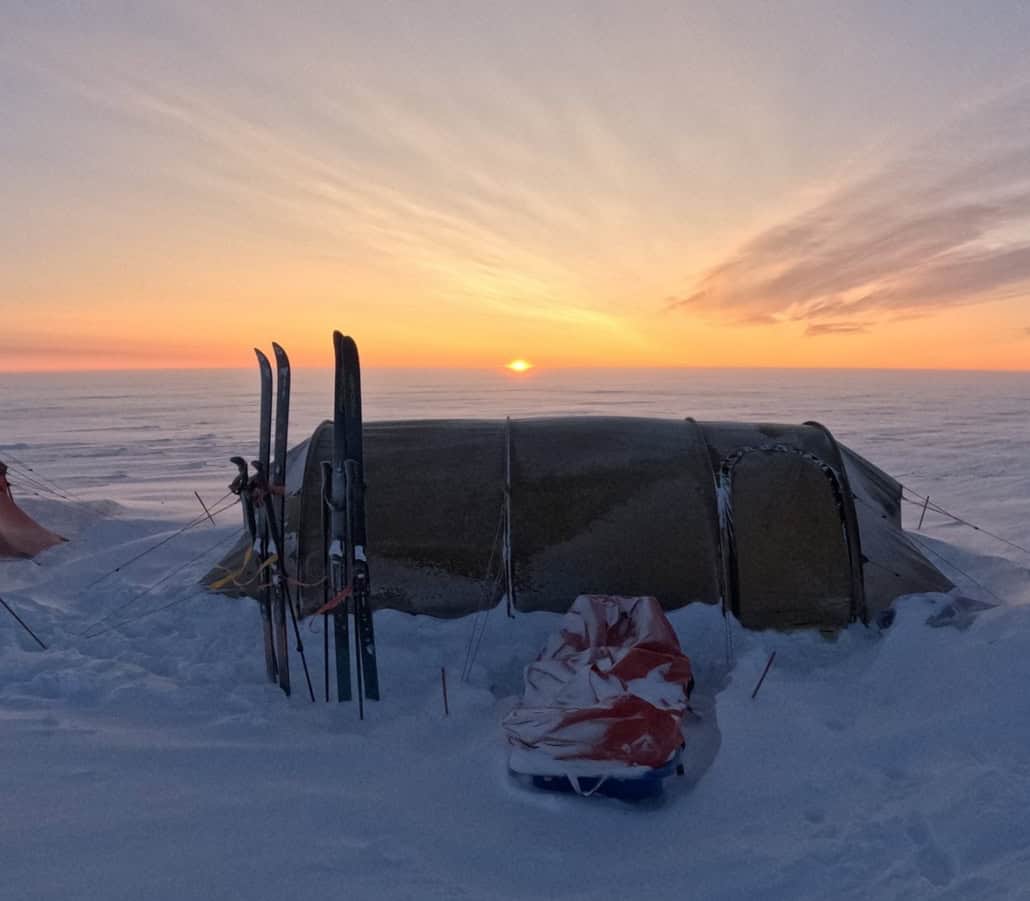
Preparing for an expedition: packing list for a Greenland adventure
Listen to the Greenland Expedition Update
Sign up for the Expedition Newsflash.
Receive alerts of new blogs in your email during the expedition.
Why I’m recording these blogs and testing the sequence
Yes, we’re still in the middle of preparations for the expedition to Greenland. One of the reasons for me to record these blogs is to take you, as a listener or reader, along for the whole story of the expedition. But a very practical reason for myself is testing the entire sequence. I’m recording this blog post, and from the Greenland Ice Sheet, Karin and her team will hopefully record this blog post daily via satellite phone. Eventually, using a few tools, this blog post will be transcribed as a blog. You can also listen to it on the website, and for those who want, an email will be sent out whenever a new blog goes live. To avoid doing all of this manually, I want to automate it. It all needs to be tested so that once we’ve finally started the expedition, we only have to focus on one thing: executing the expedition well. So that’s one of the reasons to start with this whole sequence in advance.
The packing list and clothing categories
I also want to take you through the expedition itself, because there’s quite a lot involved in an expedition like this. I’ve mentioned the packing list a few times, but what exactly is on such a list? I’ve divided the packing list into several elements: feet, legs, torso, hands, and the face. With those categories, you eventually cover everything you need in terms of clothing.
Clothing for the feet
Looking at the feet: we put on a thin liner sock on the Greenland Ice Sheet and over that a VBL, a so-called Vapor Barrier Liner. To put it bluntly, you could also say: it’s a plastic bag. That VBL ensures that the sweat from your feet doesn’t get into your shoes but stays in the small, thin liner sock. Over that VBL, you put on a thick pair of socks, and over those go your Tour Cross-Country boots. We use Tour Cross-Country boots with Tour Cross-Country skis in combination with Tour Cross-Country bindings. They all have the same standard: the NNN-BC standard. That stands for New Nordic Norm, and BC stands for Back Country. Because everyone in the team has the same ski bindings, we can work more easily with repair materials. We only need repair materials for one type of ski binding, which simplifies things. For the expedition, we also need tent slippers for inside the tent. These should have a smooth sole so you don’t bring snow inside if you step out for a moment. They shouldn’t be made of fleece either, because snow sticks to that, and then you take it into the tent or it melts and you get wet feet.
Clothing for the legs
For the legs, underwear is obviously on the list, and everyone can decide for themselves how much underwear they bring. Furthermore, long johns and windproof over-trousers for during the day while moving. In the tent, it’s nice to pull on fleece trousers or thick down trousers over your legs. And you need a clean set of clothes for the journey back. That clean set of clothes is sent from Kangerlussuaq, where we start, to Kulusuk, the village at the end. When we arrive there, clean clothes will be waiting for us. For the legs, gaiters are also on the packing list. These are a kind of leg coverings that ensure snow doesn’t get into your shoes. Some shoes have built-in gaiters, so you don’t have to bring them separately.
Clothing for the torso
For the torso, you bring a t-shirt to sleep in. It can sometimes be warm on the Greenland Ice Sheet, and then it’s nice to just have a t-shirt on in your sleeping bag. During the day, you wear a long-sleeved base layer, or a thin shirt with long sleeves. Over that, a fleece sweater and over that a Gore-Tex jacket to keep out the wind. On colder days, there’s a wool jacket or cardigan in between. Most expedition participants have a fur collar sewn onto the jacket to break the wind. We also have a down jacket with us for the really cold moments, such as breaks, in the camp in the evening, or early in the morning when we leave and the sun isn’t up yet. Then it’s nice to walk in your down jacket. And a very strange one on the packing list is an emergency poncho. One of those 1-euro festival ponchos. We take a few of those along because it can sometimes rain, even on the Greenland Ice Sheet.
Clothing for the hands
The hands are a precarious part, because along with your toes, the tip of your nose, and your ears, they are the extremities, and they are the first to get cold. We bring wrist warmers. They are super nice to wear. There are two large arteries or veins at your wrists, and a lot of heat comes from there. If you protect your wrists, you can regulate the heat well. During the day, we wear thick wool mittens so your fingers are together, with windproof over-mittens on top. For really cold days, we have down mittens. In the evening in the camp, you want to be able to use your fingers, so then we wear gloves. Those are gloves that can handle snow well, like ski gloves or leather gloves. Fleece is out of the question.
Clothing for the face
For the face, we bring a hat that can at least cover the ears, because those are extremities you want to keep warm. We also bring a cap because the sun can be incredibly intense. Even better is a desert cap. It’s light and provides good protection for the neck and face, so the reflection of the sun on the ice doesn’t hit your face directly. You also bring a buff, or a neck gaiter. It’s nice to bring two thin ones so you can combine them. On a really cold day, you just add the second one. With a buff and a cap or hat, you can make a balaclava, so you don’t have to bring a separate one. Finally, you have glacier glasses and ski goggles. Glacier glasses are necessary and must seal well around your eyes because of the enormous solar intensity in Greenland. For windy days, you bring ski goggles. If you wear glasses, make sure to get OTG ski goggles, or over-the-glasses, so the goggles fit over your own glasses.
How much clothing you actually bring
During an expedition in Greenland, you’re actually wearing most of your clothes. You don’t have many clothes in your bag, so not much clean clothing either. I think: when I cross Greenland, I’ll wear one pair of underwear for 30 days and have two clean ones in the pulk. So the weight of the clothing you have with you isn’t too bad. Most of the kilos are in the food, but we can talk about that another time.



 Facebook
 Instagram
 Pinterest
 LinkedIn
 YouTube
 WhatsApp
 Arctic Adventure Happenings



Leave a Reply
Want to join the discussion?Feel free to contribute!