
Adventurous expedition on Greenland’s endless plains
Listen to the Greenland Expedition Update
Sign up for the Expedition Newsflash.
Receive alerts of new blogs in your email during the expedition.
Endless plains and a day of ups and downs
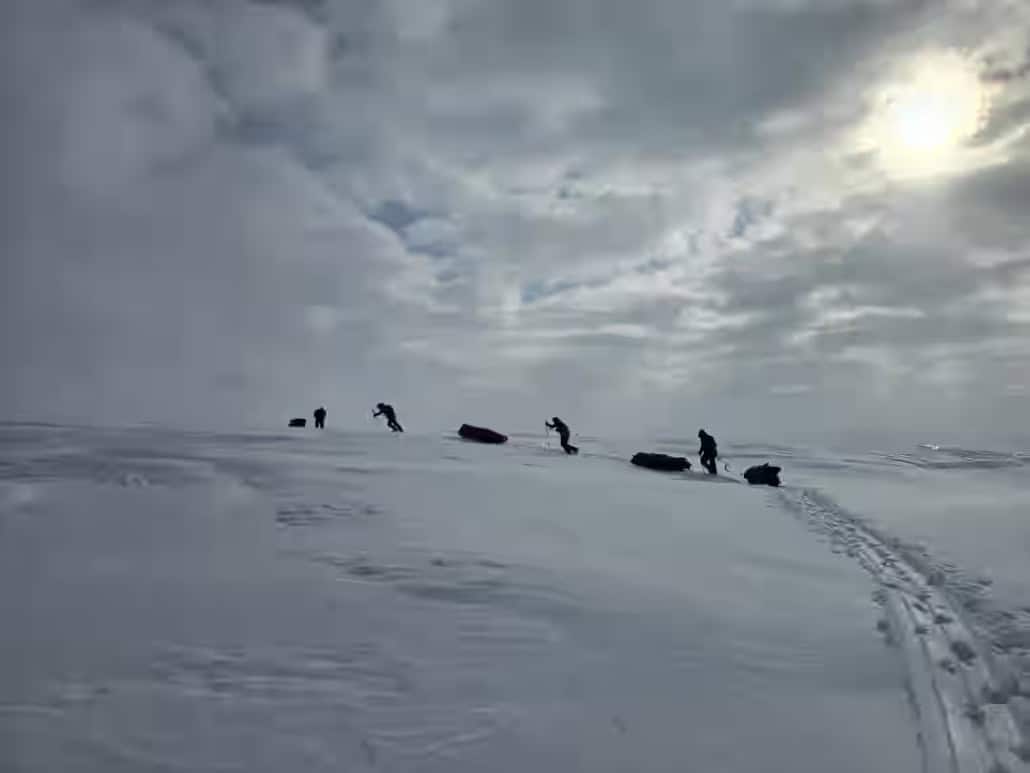
I’m recording this here on an endless plain. At the edges, we can still see some remnants of the glacier fields. The sun is just setting on the horizon and it’s been a day of ups and downs, really for the whole team. This morning I had a consultation with our basecamp myself because I thought: we’re not getting anywhere. We’re just struggling here and how is this going to work, will it be okay, are we maybe doing something wrong? After encouraging words from basecamp, it turned out we’re actually doing very well. For example, yesterday one of the other teams on the ice sheet even stayed in their tent because the visibility was so poor. And those 5 kilometers we covered in over 7 hours of slogging really bring us a bit closer to the finish line.
Safety and approach with climbing harnesses
I think we should still follow roughly the same path, with climbing harnesses on. Not on a rope, but with the harnesses on. From the waist, there’s a static rope attached with a carabiner at the shoulder, so if anything happens and someone gets stuck up to their waist, for example, or disappears a bit further into a crevasse, we can perform a rescue very easily.
Terrain, visibility and pace
Last night I had the idea that it would be quite difficult terrain to get through. But as it turns out: with visibility, it was actually easy peasy. We went through it so fast, really like a rocket. We covered more than 2 kilometers in the first hour. By the time we started the second break, we’d already pretty much covered yesterday’s daily distance. It makes a huge difference whether you navigate through such terrain with or without visibility. The nice thing was that because of this, everyone got a turn to practice navigating and finding your way through that rolling terrain, to keep elevation gain to a minimum. That means you have to zigzag through the bumps a bit while still maintaining roughly the right course, which is super tricky. But yeah, that’s a matter of lots of practice and we did that today.
Problems with boots and solution
Expedition also means you have to switch strategies if something isn’t working. During the second break, we took off someone’s hiking boots. They were wet, they were frozen in the morning, and there were wet socks and wet feet inside. He’d actually been walking with cold toes for 2 hours. When I heard that, I said: okay, we’re taking those boots off right now. We checked his toes and luckily it was just in time. But I made him continue in backcountry ski boots. That was a bit of a hassle with the mini-crampons, because they have a rubber rim you have to pull around the boots, with little irons and spikes on the bottom. A backcountry ski boot is obviously quite a bit bigger than a hiking boot. But if one thing doesn’t work, you have to try the other. Soon his feet were warm and comfortable again, so that went well.
Course adjustments and terrain
We were trying to veer a bit to the east, but the terrain kept pushing us slightly to the southwest, where it’s just a bit easier to walk. On top of that, visibility dropped again. Before we knew it, we were navigating through a massive crevasse field again, up and down and left and right, scouting and taking on steep slopes. I thought: this just isn’t working at all. So we made a radical course change and walked straight north—well, as straight as possible in between—to veer east again at another point. That worked.
Deep snow and switching to skis
After that, the deep snow was the main problem. Such a thick layer of snow has fallen that we were slogging through it about ankle-deep. Especially for the first person, it’s super heavy to pull your pulk through it. Then we thought: deep snow is the problem, that’s what we have skis for. So we put on our skis much earlier than expected. After a few start-up struggles, we managed to cover quite some ground on that snow.
Last shift, camp and looking ahead
The last bit: we actually wanted to keep going a bit longer because we had good weather, but time was really up. For the last shift, we did 8 minutes per person, but even that didn’t really work anymore. So we made camp here where we ended up after the last person—well, the second to last, but anyway, when you’re done, you’re done. We made camp, the sun came out again and it was such a wonderful feeling to be on skis. Everywhere you look, you see white. Now, we’re going to be doing that for another 28 days, so maybe we’ll get tired of it at some point. But for now, we’re really happy that we’ve had the hardest part and can now crawl into our tent and continue tomorrow.




 Facebook
 Instagram
 Pinterest
 LinkedIn
 YouTube
 WhatsApp
 Arctic Adventure Happenings



Leave a Reply
Want to join the discussion?Feel free to contribute!