

Arctic Adventure’s steps to sustainable business
Sustainability policy of Artci Adventure
Today is Sept. 27, 2019. The last day of the 2019 Climate Strike . I can’t imagine a better day to write an article about Arctic Adventure’s contribution to the climate.
Arctic Adventure is a travel agency. We and our participants travel to Arctic regions. With our travels, we have an impact on the environment and the climate. That’s right. I too am just creamier than the Pope so I will be the last one to say it is not so.
But, I am aware of the negative impact on the environment. And I am also aware of the positive impact on the participants of the trips.
With the trips, among other things, I want to show the beauty of nature. Making people even more aware of the splendor we have in Arctic.
What I strive for is to also have a positive impact on the environment with my travels.
Below I outline how we do it now. Do you see an opportunity to make our contribution to a better environment even greater? Let us know in the comments below or send me an email.
Transportation to the shipping area
We fly to the areas where we expedition. True. Often the areas we go to are more than 1,000 kilometers from Utrecht. Almost impossible to get there in one day. And with limited vacation days, participants do not want to travel for two days before reaching their destination. Only to have to leave after 6 days.
As I write this, an idea to develop a slow journey does sprout. Two days by train to northern Sweden, spend ten days there and then slowly return to Holland in two days. It’s about the journey, not the destination… Who knows.
We offset air travel with Trees for All’s CO2 offset program. this we do double.
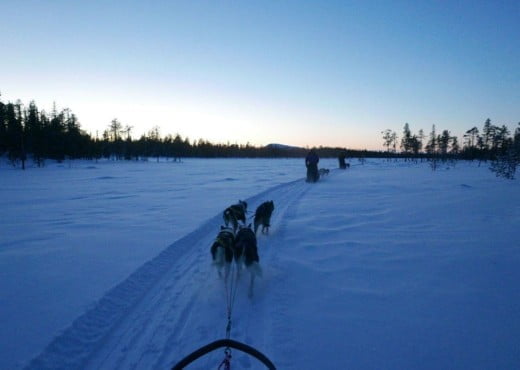
Locally (from the airport) we use bus, train, cab van. If really necessary, we still sometimes want to use a snowmobile. But that’s just to get to the start of the tour. There will be no motorized transportation during the tour. Then we go by ski, snowshoe or dog sled.
https://www.rome2rio.com/map/Utrecht/Kiruna
Material we use during an expedition
In the consumer society we live in, there is a lot of buying and little real use. Having the business is the end of entertainment. Yes, I too am guilty of this. At Arctic Adventure, we have a lot of equipment. Lots of material. Think sleeping bags, tents, stoves, sleds, skis, shoes.
But that material is used. It’s not in the closet. Suppose you need to buy your own expedition sleeping bag for a trip. Chances are you’ll use it once or twice more after the trip. But let’s face it. The tent you might have, how many weeks is it in storage or in the attic? We use the materials for all of our participants. This way, things are actually used. And if we don’t use them we rent the materials. In this, having the business is the beginning of the entertainment.

Second-hand stuff is also very good
Many materials are also good to buy second-hand. We often scour Marktplaats in search of a stove, sleeping mat or other necessary expedition materials. An MSR burner will easily last 20 years if you are careful with it. So a used burner a few years old could be super useful. And so we avoid having to produce a new burner and are happy with a good used one. (Which are often still as good as new)
https://www.marktplaats.nl/q/msr+brander/
This is how we handle food during an expedition
Per year, a Dutch person wastes 41 kilograms of food. That’s almost 800 grams per week. Source : https://www.milieucentraal.nl/persberichten/2017/nieuwe-cijfers-voedselverspilling-in-huishoudens-2016/
At Arctic Adventure, we bring our own food during the tours. 1,100 grams per person per day. 5,000 kilocalories. And that often goes all out. Sometimes food is left over. Then consider an evening meal. In turn, I use this meal myself during my own expeditions. That’s the advantage of dried food. It has a long shelf life, making it easy to take to another trip a few weeks or months later.
The plastic that contains a lot of food (still unavoidable) is left separated at the initial destination.
I purchase the nuts we bring in large quantities from noten.nl. They specially package that in one package per participant for the entire trip. With this, I avoid small bags and small packaged quantities.
Today, Sept. 27, 2019, I signed the Plastic Pledge for the tourism industry. An initiative to drastically reduce plastic consumption in the tourism industry.
https://futureproof.community/cirkels/sustainable-tourism

The fuel we consume
To prepare food and to get water, we have to melt snow. We drink the water, make tea and coffee from it and put it with food. There is 180 ml of fuel per person per day. Preferably Aspen 4. That’s lawnmower gasoline. A very clean fuel. Soot emissions are minimal. This also makes the burners last longer. This 180ml per person per day is less, in my opinion, than an average Dutch person consumes per day in the Netherlands.
We sleep in a tent with a super good expedition sleeping bag. The stove remains off.
I dare say that if I have a month-long expedition over Greenland, I use less energy than if I had stayed at home. This is quite a statement and so I invite you to check it out.
This is where I need your help: I would like to calculate what my energy consumption is when I am on expedition versus the consumption when I stay at home. Can you help me with this calculation? If so, please contact me.

Electricity and charging devices
There is no outlet in the snow. I charge my electrical devices during longer expeditions (Longer than a week) via a solar panel. The devices last fully charged at the beginning. That charging is done through the power outlet. Now I have solar panels on my roof at the home office. So I say for the sake of convenience that it’s all-green power. (Well also those panels have to be produced and that also costs material and energy. I know)
The devices I bring are: Satellite phone, walkie-talkie, still camera, 360 degree camera, smartphone, power bank, GPS, emergency beacon.

Arctic Adventure’s office. As sustainable as possible
Arctic Adventure operates out of Utrecht. I have a home office here. Saves travel time, travel expenses and I don’t need an extra room for activities that really just need a desk for a computer.
The guides we work with don’t have to be in an office either. Consultations we do via WhatsApp, by phone, Skype and occasionally we meet. For that I meet here in Utrecht or somewhere in a café. So an office is not necessary.
Our trips
When putting together our trips, we consider people, environment, nature and culture, so that the vacation is not only special for you, but also future generations can enjoy attractive destinations.
Whether it’s vacations where you enjoy pristine nature, experience local culture, meet new people or taste a delicious local dish; together we work to create vacations that make for better places and more beautiful experiences. And in doing so, we make an important contribution to sustainable development at the destination. For you as a traveler, but also for the people living at the vacation destination.
Communication with our participants and advertising efforts
I have resolved to go paperless as much as possible. So I use digital tools like Google drive, video, WhatsApp.
We do have a brochure. It is printed on durable and sturdy paper. Not something to throw away immediately upon receipt. The insert of this brochure with the current offerings is printed on much lighter paper. And exactly in the number we need. Is also a waste of money to print too much. And so you see that environment also has to do with money with us.
Online, the current list of tours can be found here: https: //arcticadventure.nl/expedities-overzicht/
1% for the Planet
Since the summer of 2022, Arctic Adventure has been affiliated with 1% for the Planet. With this, we give 1% of our sales annually to nature-related charities. We have chosen for our gifts:
- 1% for the Planet
- Trees for All
- Rewilding Europe
- Protect our Winters
This is how I see the future of Arctic Adventure
At Arctic Adventure, we also look to the future. We are working with an NGO. A Next Generation Officer. Someone to whom decisions are tested to see that it does not have a negative impact on the next generation. In my case, I consult with my son Björn. He is smart, enterprising, thinks from his point of view and he is almost turning 12.
Discussing things with him puts me on edge. Can I justify my decision to him? And to be honest, I really have a problem with flying. I am in my stomach with that. Because is the CO2 offsetting enough?
I have heard the saying, “Save the world, kill yourself.” But then again, that’s so drastic and I don’t think many people will warm to it. I prefer to let people experience the beauty so that there is intrinsic motivation to save nature, the environment and ourselves. Yes also ourselves. Because we are an inseparable part of nature. We are not outside of it with only economic growth as a measuring point. I prefer to grow in positive amazement.
Would you like to contribute to Arctic Adventure’s sustainable quest? Contact me. I am open to change and surprise.
Henk-Jan Yellow
Polar guide and CEO Arctic Adventure


Wij organiseren expedities in Arctisch gebied.
Van laagdrempelige reizen voor de sportieveling tot zware expedities voor de echte avonturier.


 Facebook
 Instagram
 Pinterest
 LinkedIn
 YouTube
 WhatsApp
 Arctic Adventure Happenings


Leave a Reply
Want to join the discussion?Feel free to contribute!