

Navigating in Greenland’s White-Out: an Expedition Report
Listen to the Greenland Expedition Update
Sign up for the Expedition Newsflash.
Receive alerts of new blogs in your email during the expedition.
A New Day on the Greenland Ice Sheet
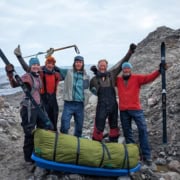
After a well-deserved rest day, the Greenland Expedition Team is back on track. On Wednesday, September 3, day 21 of our expedition, we began setting a new course on what looked like a blank sheet of paper. The snow had almost completely buried our pulks, but thanks to using marker poles as anchor points, we quickly found them.
Navigating in a White-Out
The challenge of the day was navigating in a complete white-out. This makes navigation particularly difficult, as there are no visible reference points. We had to rely on the wind vane and the swirling snowflakes blowing over our skis. These flakes helped us maintain the right course; if they didn’t fly straight over the skis, we had to adjust. Our first destination was a weather stake for which we had the GPS coordinates. Unfortunately, we couldn’t find it, even though we could still see each other from 20 meters away. We therefore decided to head directly to the weather station of Dirk van As, our meteorologist, where we hope to arrive in three days.
Changing Terrain and Colder Weather
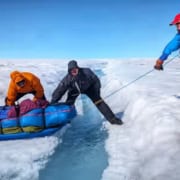
The terrain beneath our feet changed throughout the day. We walked over frozen lakes and snowfields, sometimes as long as 10 kilometers. At the end of the day, we set up our tent in just 10 centimeters of snow with an icy layer underneath, which forced us to use ice drills for extra stability. The weather is getting colder, which is favorable as autumn sets in and meltwater could otherwise pose a problem. We’ve already experienced a night with temperatures of minus 18 degrees Celsius and expect this to occur more frequently.
Staying Warm in the Freezing Cold
A good sleeping bag is essential for staying warm in the tent. I personally use a thick expedition sleeping bag with a thin summer sleeping bag inside as a liner. It’s important to get into your sleeping bag warm, so make sure you eat and drink enough before going to sleep. Wear suitable clothing such as long johns and undershirts, depending on the temperature. I also take damp clothing into my sleeping bag to dry, as well as my mobile phone and power bank to keep them charged. This way, I am well prepared for the cold nights.
Daily Statistics
We set off at a quarter past six in the morning, before sunrise, and stopped at 4:00 PM. In total, we covered 27.5 kilometers in a straight line from our previous camp. So far, we have covered 437 kilometers, with about 125 kilometers to go. Tomorrow, we’ll see how many more kilometers we can cover.




 Facebook
 Instagram
 Pinterest
 LinkedIn
 YouTube
 WhatsApp
 Arctic Adventure Happenings




Leave a Reply
Want to join the discussion?Feel free to contribute!