
Communication and Electronics on the Greenland Ice Cap Expedition
Listen to the Greenland Expedition Update.
Sign up for the Expedition Newsflash.
Receive alerts of new blog posts in your email during the expedition.
Communication Equipment and Electronics During our Greenland Expedition
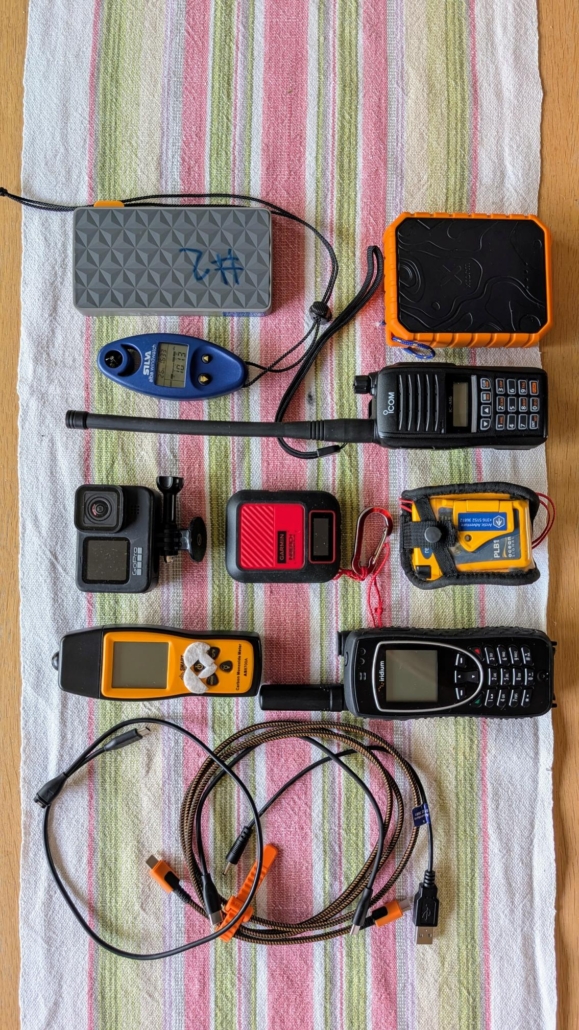
During our expedition on the Greenland ice cap, we use various communication tools and electronic devices. In this blog post, I’ll take you through the different devices we use and their functions.
Satellite Phone: the Iridium Extreme
A frequently asked question is how we communicate from the Greenland ice cap. For this, we use a satellite phone, the Iridium Extreme. This phone looks like an old Nokia 5110 and can actually only make calls. The big advantage is that it works in places where normal phones have no reception. We call our Basecamp manager every other day, and in case of emergency, we can call emergency services. The Iridium Extreme is lighter than previous models and has an SOS button, which alerts emergency services when needed.
Garmin InReach Messenger Plus
To send images and track our location, we use the Garmin InReach Messenger Plus. This device is part of the Garmin InReach series, which allows you to track yourself and send text messages, similar to texting. With the Messenger Plus, we can also forward photos and audio messages.
Personal Locator Beacon (PLB)
In case of emergency, we have a Personal Locator Beacon (PLB) from Ocean Signal with us. This device functions as an emergency beacon when other means of communication no longer work. It sends a distress signal to a central location in America, which then sends rescue services to our location.
Air to Ground Radio
For communication with helicopters, we have an Air to Ground radio from ICOM, model IC-A16. This allows us to contact pilots if necessary. There is also an emergency channel available for communication with aircraft.
Other Equipment
In addition, we have a wind meter to measure wind, air pressure and temperature, and a carbon monoxide meter for the tent. This meter warns us of dangerous levels of carbon monoxide during cooking. We also take a GoPro to capture images. I also wear a Garmin watch with solar cells, which lasts up to twenty days on a single battery charge. I use my smartphone for navigation and sending photos via the Garmin InReach.
Charging Equipment
To charge all these devices, we have two power banks and a solar panel from Xtorm with us. During the day, the solar panel is on my sled to charge the power banks, after which I charge the equipment in the tent in the evening. The priority is charging the satellite phone, followed by the Garmin InReach, my smartphone and finally the GoPro. I hope this comprehensive update on our communication equipment is useful for your own trip. Have questions? Leave them in the comments!




 Facebook
 Instagram
 Pinterest
 LinkedIn
 YouTube
 WhatsApp
 Arctic Adventure Happenings



Leave a Reply
Want to join the discussion?Feel free to contribute!